Research
Triboson
Search for the Production of Three Massive Vector Bosons
The Standard Model of particle physics describes how fundamental particles interact, but we continue to test its predictions to uncover any new physics. My research focuses on studying the production of three massive vector bosons (the carriers of the weak force: the W and Z bosons) using data from proton collisions collected by the ATLAS experiment at the Large Hadron Collider.
This process, triboson production, is a sensitive probe for testing the Standard Model’s triple and quartic gauge couplings and the Higgs boson’s coupling to the vector bosons. Additionally, certain theoretical frameworks, such as large extra dimension models, predict a higher rate of production of triboson events. This process is extremely rare, with a cross-section of less than 1 picobarn. To differentiate the triboson signal from the background, we use advanced machine learning techniques, including neural networks and boosted decision trees, to improve our ability to distinguish between signal and background events.
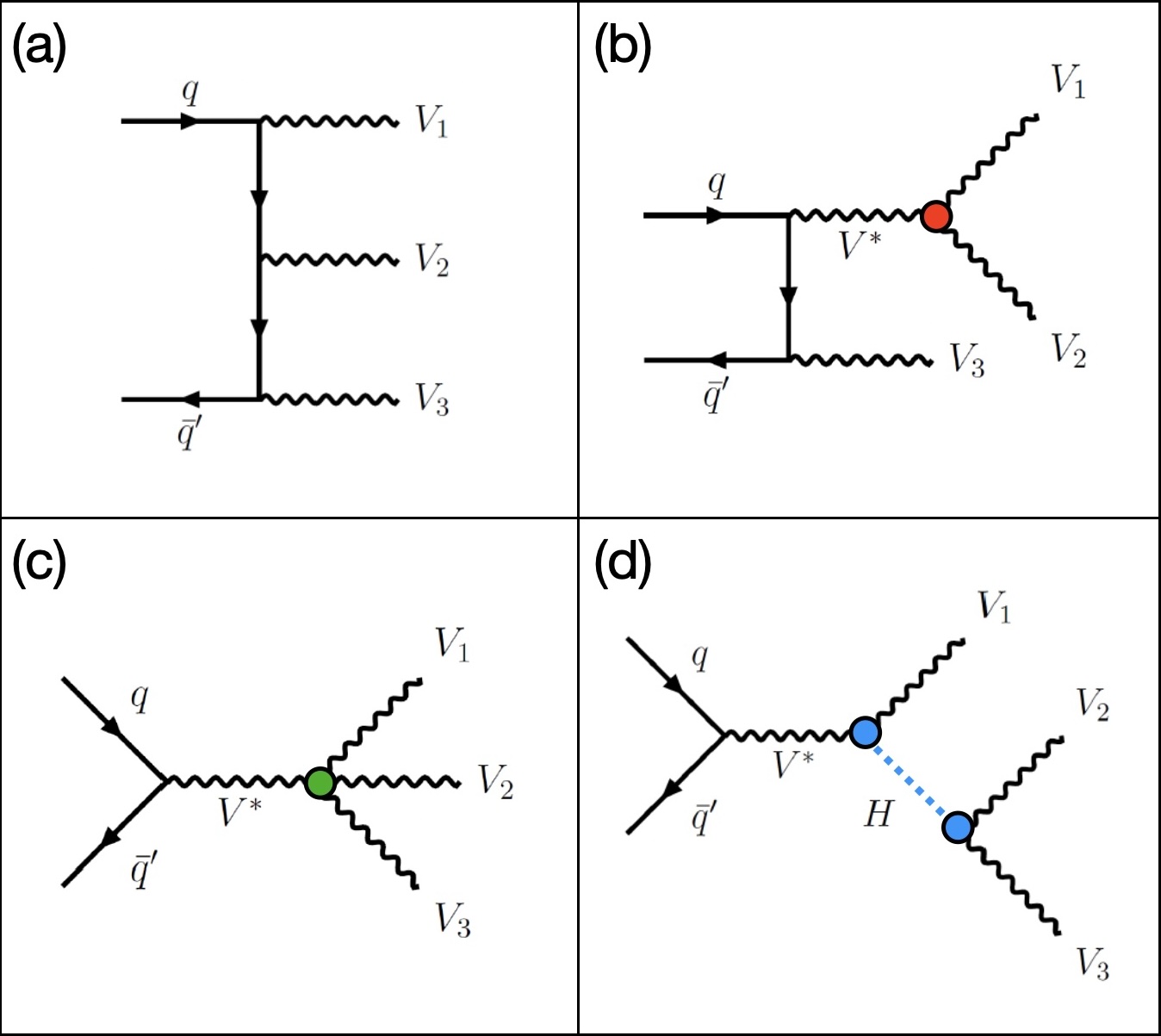
Leading Feynman diagrams for triboson production in the Standard Model, $\sim \mathcal{O}(\alpha_W^3)$: directly from quarks (a), and through gauge couplings: triple (b), quartic (c) and Higgs (d).
New Small Wheel (NSW) Upgrade
Commissioning of the upgrade to the ATLAS Muon Spectrometer
Muons are heavier cousins of electrons and play a crucial role in particle physics experiments. Detecting and measuring muons with high precision is vital for exploring new physics phenomena. The New Small Wheel (NSW) project is an upgrade to the end-cap muon spectrometer of the ATLAS detector at the Large Hadron Collider. This upgrade is critical for improving the ATLAS detector’s ability to measure and identify muons with higher precision and efficiency in order to cope with the anticipated higher muon rates of the future high-luminosity Large Hadron Collider (HL-LHC).
The NSW utilizes Micromegas technology, a type of gaseous detector that provides excellent spatial resolution and fast signal response. The commissioning process includes the installation, calibration, and optimization of these Micromegas chambers. Additionally, the project involved developing C++ software for the detector geometry, essential for estimating spatial resolution, noise levels, and accurate data interpretation and analysis.
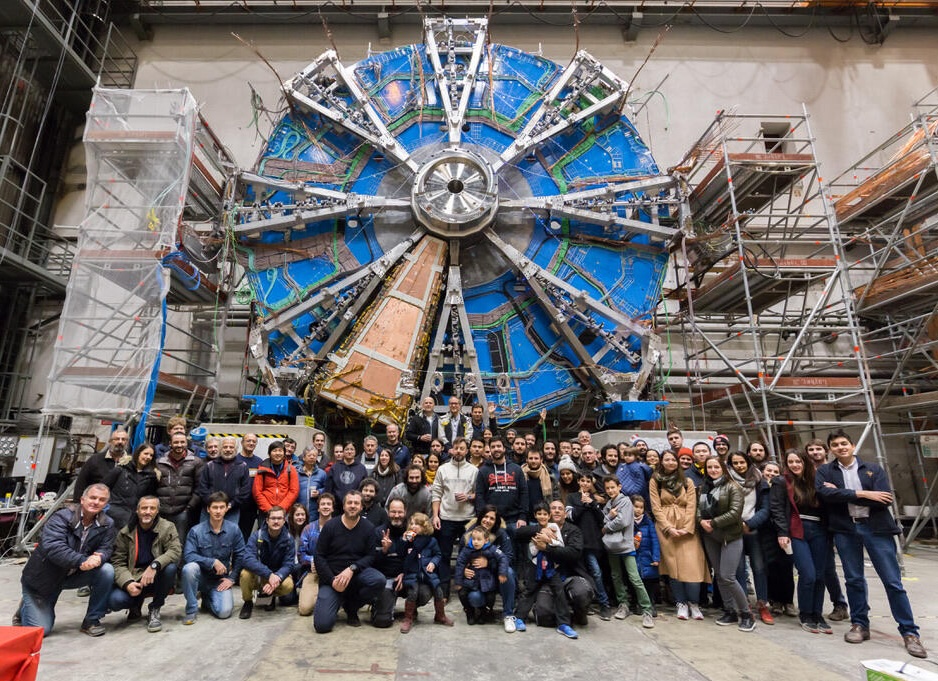
Members of the NSW collaboration in 2019 in front of the first NSW frame with the initial detector "wedge" in place (1 out of 16). I am positioned at the far right end.